Payment received. We have your order.
Setting up your order…
Send us the solicitation and its attachments. Within 5 minutes of receiving them we email you a firm delivery time based on the documents themselves. Every report is reviewed by a person before it is sent, and that review is included in the time we quote you.

Awardly Edge
You have read this solicitation. So has everyone bidding.
The bid you lose is rarely the one you were unqualified for. It is the one where the deadline moved in an amendment and the cover page still showed the old date. Or where an attachment put an obligation on you at no additional cost, and the pricing section never mentioned it. Or where you wrote forty hours of proposal against evaluation factors that turned out to sit in a different document.
None of that is hidden. It is spread across a package that can run past 135 pages before the attachments, and the parts that decide a bid are rarely in the notice.
Awardly Edge reads the whole package — the solicitation, every attachment, the wage determinations, the labor agreements — and tells you what will impact your bid, with every figure traced to where it came from. Every report is reviewed by someone who writes federal proposals before it is sent.
What a report answers
- Who holds it now, and what it has gone for
- Know who you are up against, and what the work is worth, before you commit forty hours.
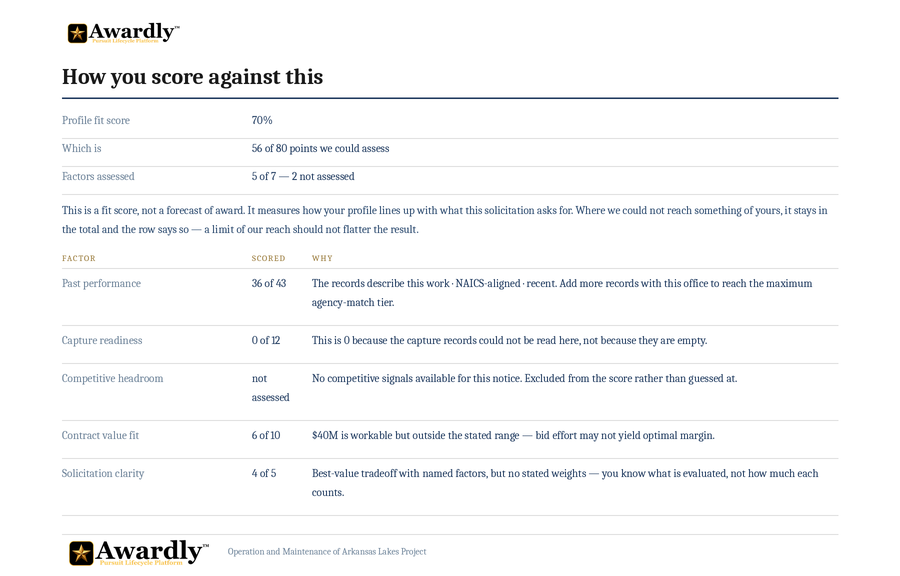
- How you score against this
- Where you are strong, where you are short, and whether it is worth bidding at all. Tell us about your firm and it scores you; leave it blank and the report says so rather than guessing.
- The dates that matter
- The ones in the amendments, not the ones on the cover page.
- Whether you can bid
- Set-aside, size standard, licenses, clearances, settled on day one rather than day nine.
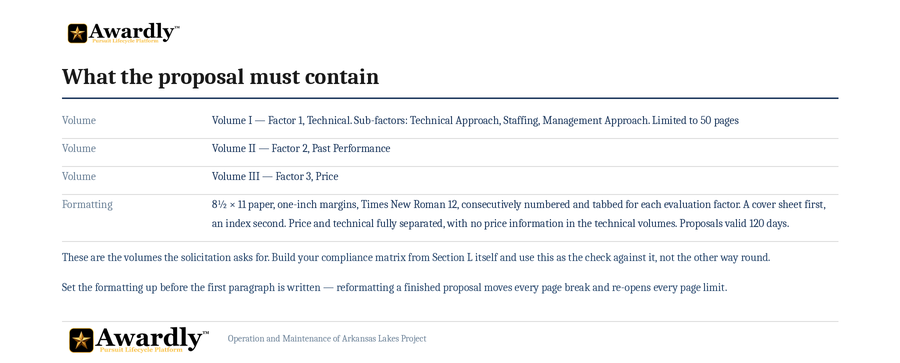
- What your proposal will be scored on
- Write to what the evaluator actually reads.
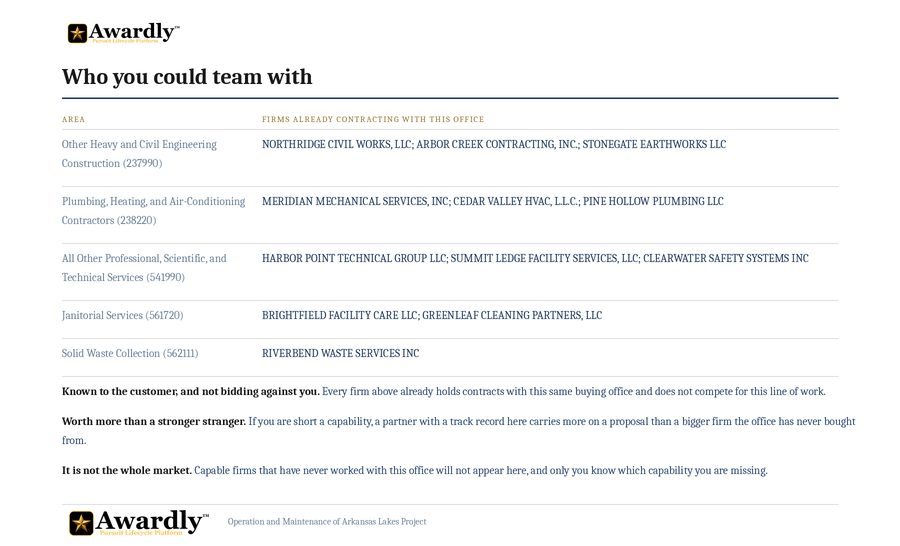
- Who you could team with
- Firms already working at this office, named.
- The clauses that decide a bid
- The unpriced obligations, the response windows, the costs an attachment adds that the pricing section never mentions.
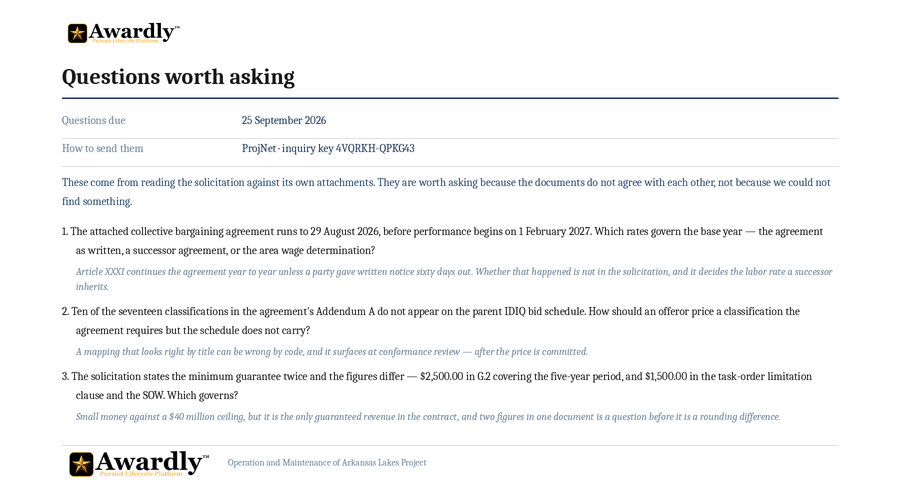
Three of those are a proposal roadmap. What the proposal must contain, what it will be scored on, and who you could team with are the outline you write against, before you have written anything.
How it is made
The pipeline reads the documents and writes the report. Every figure is traced to a source and checked before it ships.
The review is done by someone who writes federal proposals for a living — not a proofread, a judgment about what matters in this pursuit and what we could not establish.
Where we could not establish something, the report says so — "we looked and found nothing" and "we did not look" are different sentences.
What a report contains
Those seven are what the report is organized around. It also carries these, and the sample below is the whole thing in order:
DECIDE
- How big they are
- Labor rates and wage floor
- Questions worth asking
COMPLY AND OPERATE
- Licenses and permits
CONTEXT
- How this office buys this work
- Protest history
- What to ask before you bid
- One thing that could change everything
- Where this came from
- About Awardly
Read one before you buy one
Operation and Maintenance of Arkansas Lakes Project — U.S. Army Corps of Engineers, Vicksburg District. A real solicitation, read in full.
It found the incumbent named in a collective bargaining agreement and invisible in the award record; ten of seventeen wage classifications missing from the parent schedule; and the same minimum guarantee stated twice, as two different numbers.
Download the sample report (PDF, 628 KB)
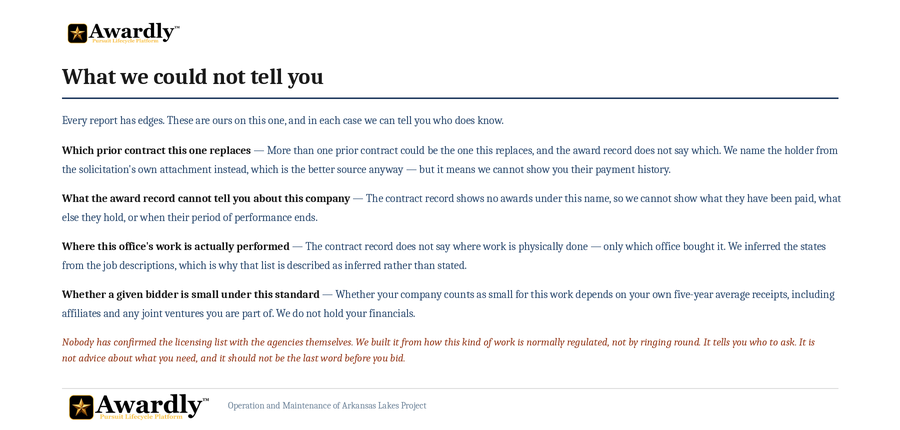
Published with permission, the buyer’s identity removed.
Price
Six parts, every figure traced to its source, reviewed by a proposal professional — and a section that tells you what we could not establish and who does know. You will spend more than $195 of your own time reading this package before you decide whether to bid.
$195 is an introductory rate. It will rise as the product proves itself.
It applies to this report, not to you forever. Buying one now does not hold the price for the next.
Order one
Tell us which solicitation. We deliver your report within one business day of receiving your documents, including the review every report gets before it is sent. Within five minutes of their arrival we email you the exact time it is due. That tells you whether the report lands before your deadline.
We refund in full if we cannot read the solicitation and its attachments — either because you do not send them, or because what arrives cannot be opened. That is the only refund condition: a delivered report is not refundable, and one that reads the documents and finds little is still the report. It costs you nothing to find out whether we can read your pursuit.
No account, no subscription. You are buying a document.
Edge is one part of Awardly. The federal position lookup and the small-business office directory are free at awardly.app, and the wage determination, size standard and receipts-averaging tools are free at awardlytoolbox.com. No account needed for any of them.